Adrian Nathanael

Hello,
I'm Adrian.

Download CV

Curiosity, shaped into useful work.

Finding meaning in data.

Exploring data analysis and machine learning to turn information into practical insights.

Building with intention.

Developing applications and tools with an interest in clear, dependable systems.

At a glance

A few things
along the way.

A snapshot of the work and achievements featured in this portfolio.

03Featured projects
03Awards featured
03Team project experiences

BETIS

Backend Developer

Visit betis.id

Contributed to backend development for BETIS by building and maintaining CRUD-based application capabilities with NestJS. Worked on API structure, request validation, data flow, error handling, and maintainable service organization while collaborating with the development team.

Highlights

  • Designed and maintained RESTful CRUD endpoints
  • Organized backend logic with NestJS modules, controllers, and services
  • Applied validation and consistent error handling
  • Collaborated on feature integration and maintenance
NestJSTypeScriptREST API

COMPFEST

Software Engineer

Visit compfest.id

Worked on backend application features using NestJS and Drizzle ORM, with an emphasis on clean architecture, SOLID principles, maintainable modules, and clear separation of responsibilities.

Highlights

  • Built and maintained CRUD functionality with NestJS
  • Used Drizzle ORM for typed database access
  • Applied clean architecture concepts and SOLID principles
  • Structured features for maintainability and testing
  • Collaborated across product and engineering requirements
NestJSTypeScriptDrizzle ORMPostgreSQLClean ArchitectureSOLID

Contributed to systems supporting DDP-0 activities, ranging from Django-based CRUD functionality to asynchronous grading infrastructure powered by Redis and distributed Go workers.

Highlights

  • Developed CRUD functionality using Django
  • Built asynchronous jobs using Redis-backed queues
  • Distributed grading tasks across concurrent workers
  • Used Go goroutines for parallel job processing
  • Worked on reliable execution and task-processing flows
DjangoPythonGoGoroutinesRedisDistributed Workers

Selected Projects

A modular Rust framework for building structured, extensible applications.

Furnace-rs.

Project overview

Application Framework

Technology

RustTokioAxumTowergRPCWebSocketsSeaORMPostgreSQLJWT

Links

Furnace-rs provides a structured foundation for Rust services. Its framework-neutral core organizes application components, configuration, dependency wiring, and lifecycle management, while optional integrations support HTTP, gRPC, and WebSocket applications.

The framework validates application registrations at startup and provides request validation, authentication, and error handling. Optional SeaORM integration supports persistence, while a CLI helps developers create, inspect, and run applications.

A concurrent grading service for Python submissions.

DDP0 Grader.

Project overview

Developer Tooling

Technology

GoGinRedisPostgreSQLGORMDockerPythonpytestS3

Links

DDP0 Grader is a backend service for evaluating Python submissions against hidden tests. A Gin API receives submissions and records their status, while Redis queues grading jobs for a pool of Go workers.

Workers retrieve test files from S3-compatible storage, prepare a temporary workspace, and run evaluations in Docker containers. The service records outcomes and execution information so submission results can be retrieved through the API.

Architecture

A queue and worker pool separate submission handling from evaluation, allowing grading jobs to be processed concurrently.

Personal finance tracking with intelligent transaction categorization.

Tracker.

Project overview

Personal Finance

Technology

RustFurnace-rsAngularTypeScriptFlutterDartPostgreSQLSeaORMPythonscikit-learn

Links

Tracker brings financial records, shared debts, and personal profiles together across web and Android clients. Its Rust backend uses Furnace-rs and PostgreSQL, while a transaction classifier helps assign primary and secondary categories from transaction descriptions.

The classifier is trained offline using text and transaction features. Its learned parameters are loaded by the Rust backend for native inference without a separate Python inference server. Users can correct categories and provide feedback for later training.

Model validation

The included model was trained on 15,226 samples and recorded five-fold mean accuracy of 98.80% for primary categories and 95.55% for secondary categories. These are cross-validation results on the recorded dataset, not a guarantee for future transactions.

A new project is currently in development.

Coming Soon.

Project overview

In Development

More details will be shared when it is ready.

National Finalist / 2024

OSN Informatika

National finalist in Informatics at the 2024 National Science Olympiad (OSN).
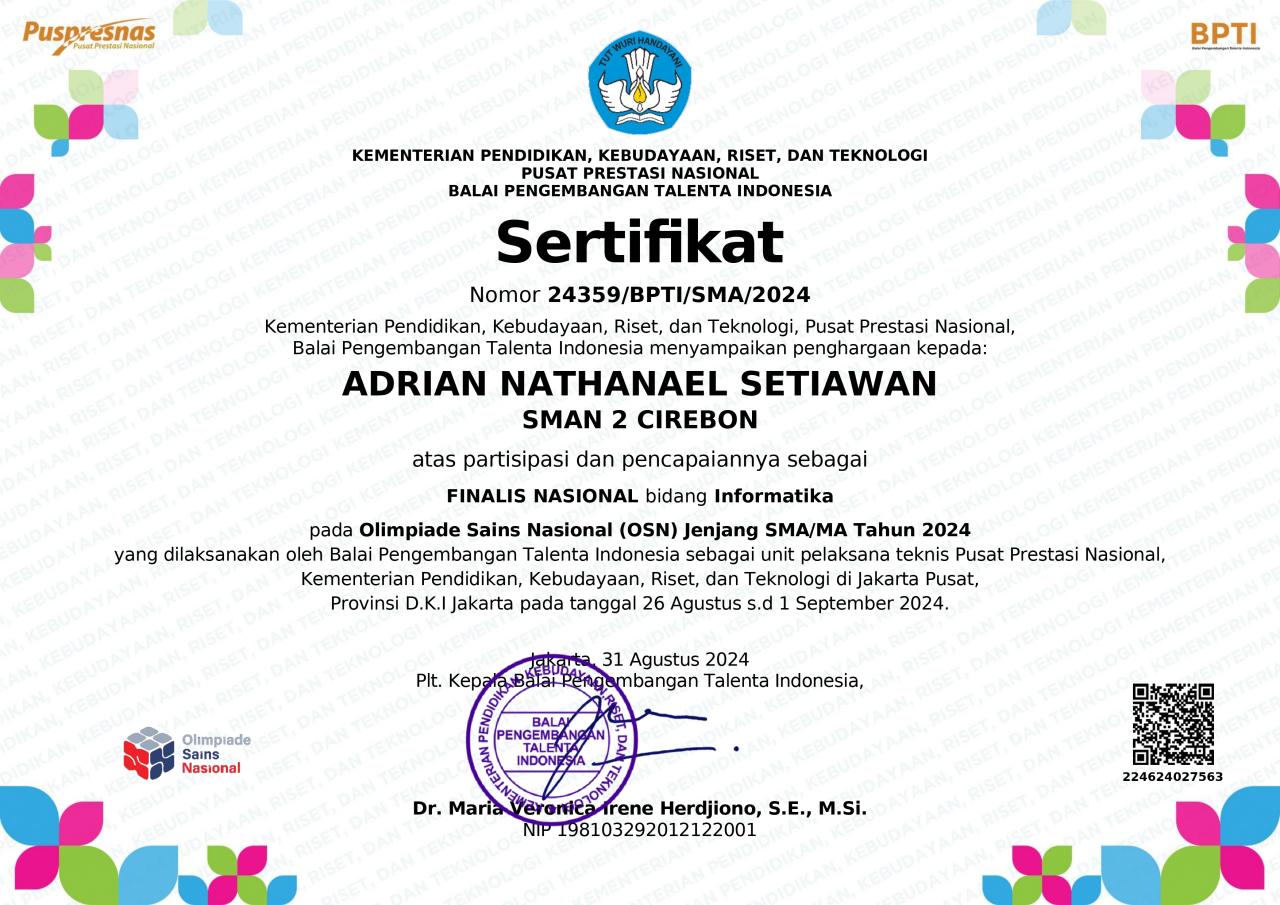
National finalist certificate for the 2024 National Science Olympiad in Informatics

Explore awards

01 / 03